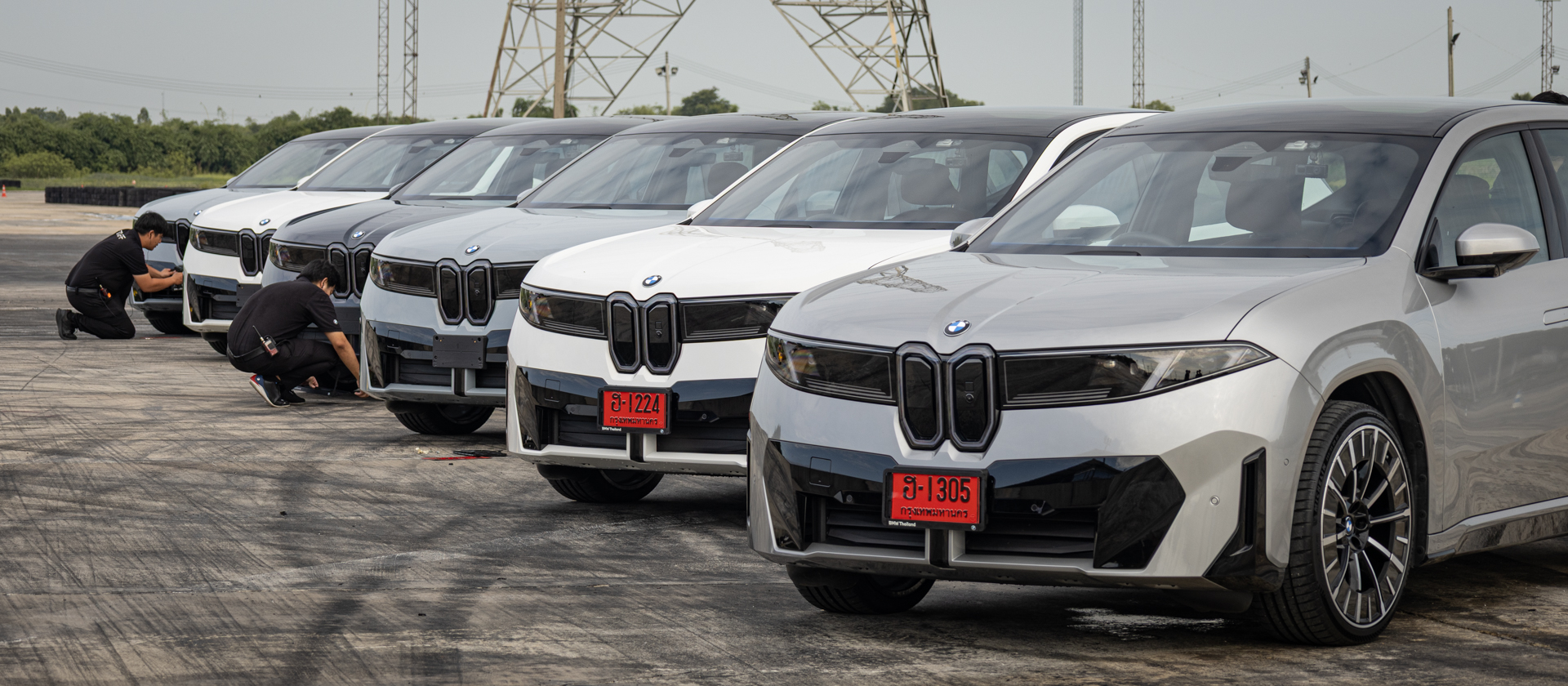
BMW really wants all of us to have a proper go in its very latest iX3. But in order to really put the car through its paces, you have to put the car through said paces. Something that you really cannot do in Singapore.
Which is why BMW decided to fly regional members of the automotive press to Thailand. More specifically to Pathumthani Speedway, where we’d be able to sample the iX3 and its platform in a more dynamic setting.

Now it may seem a little unusual letting us loose on a race track in a fleet of SUVs. But bear in mind that the Neue Klasse platform isn’t going to be used only to build SUVs – this is THE platform that’d underpin most of BMW’s EVs for the foreseeable future.
So, it not only has to work well when constrained to the form factor of an SUV, it needs to drive well enough to be used in sportier models down the line too.
On Track, On Road, In the Classroom
The purpose of the trip was to let us fully experience, and then subsequently understand, the ins and the outs, the hows and the whys of the BMW iX3. Our day started with an on-road scenic drive.

The planned route put the car in a wide array of traffic scenarios. From faster-flowing highways straight out of the race track, to slower moving traffic as we got off the expressways for our driver swaps.
As we’ve already experienced during our review in Singapore, the BMW iX3 really isn’t phased by motorway miles – with a well set-up one pedal mode and soft stop, you can really comfortably gather and then shed speed again without ever really lifting your foot off the throttle pedal.

In city driving scenarios you can utilise its adaptive regen feature to pick up and reduce momentum, knowing full well that energy isn’t wasted, but instead efficiently managed and put back into your battery pack ready for the next time you need to accelerate.
And the platform continues to impress when you start pushing the car too. Built from the ground up as a dedicated EV platform, BMW engineers could really optimally distribute all of the car’s necessary components, creating not only tons of cabin space and excellent packaging, but also great all-round weight distribution.

Which is why the car actually performs really well on track, especially when you consider it is a luxury-centric electric SUV. Partially this is helped by BMW’s Gen6 EV architecture, which sees some proper weight savings from the exclusion of a traditional floorpan, but mostly because of its Heart of Joy central brain.
To really force the car to put on its proverbial thinking cap, the track was split up into smaller stations. The first is an acceleration and brake test. We were told to accelerate to 140km/h, then brake at the designated marker.

Said marker was placed on a kink, meaning you’d need to brake and turn at the same time. And such manoeuvres will upset lesser cars. Not an issue with the iX3, as it still manages to stop in a respectable distance even when the odds are stacked against it.
Next up, a slalom. Which has been designed to showcase how the car is able to undergo changes of direction in quick succession without excessive amounts of bodyroll. To up the ante, a cup of water was attached to the bonnet – no water will be spilt if you drove through it at the suggested speed.

Then it was time to open up the taps and properly let the chassis breathe. It was pedal-to-the-metal, threading the car through a series of cones which happen to be in the rough racing line of the track. This has been designed to showcase its torque-vectoring magic, which utilises regenerative braking instead of friction brakes to control wheel speed when needed.
Finally, we’d then have to drive through a wet and soapy chicane to finish each run. Again, this was yet another test of the iX3’s Heart of Joy brain, as it has to internally balance the computations for Traction and Stability Control, as well as Torque Vectoring to cope with the traction differences.
Practical Done, Time for Theory?
The explanations above were really only possible because of the Masterclass we were told to sit through. Here, BMW had an engineer walk us through the inner workings of the iX3, including several unique design touches they built into the car.

This includes a charge flap that automatically opens when you reach your desired charger, BMW’s first ever front, and other aero and proportional optimisations to maintain an SUV shape, but not sacrifice on its overall efficiency.
The Future of BMW’s EV Evolution
The trip to Pathumthani Speedway underscored that the new BMW iX3 is more than just a luxury SUV; it is a critical showcase for BMW’s modular Neue Klasse platform. By subjecting the vehicle to demanding track tests—including high-speed braking on curves, precision slalom maneuvers, and complex traction scenarios in wet conditions—BMW demonstrated the versatility of its Gen6 architecture and the sophisticated processing power of the “Heart of Joy” central brain.

These dynamic capabilities, paired with thoughtful design innovations like automated charge flaps and advanced aerodynamic optimisations, confirm that the platform is not only capable of delivering comfort for daily driving but is also robust enough to underpin BMW’s sportier electric models in the years to come. Bring on the next batch of Neue Klasse-based cars!


Want to know what happened the last time we were at this exact track? Click here to find out!